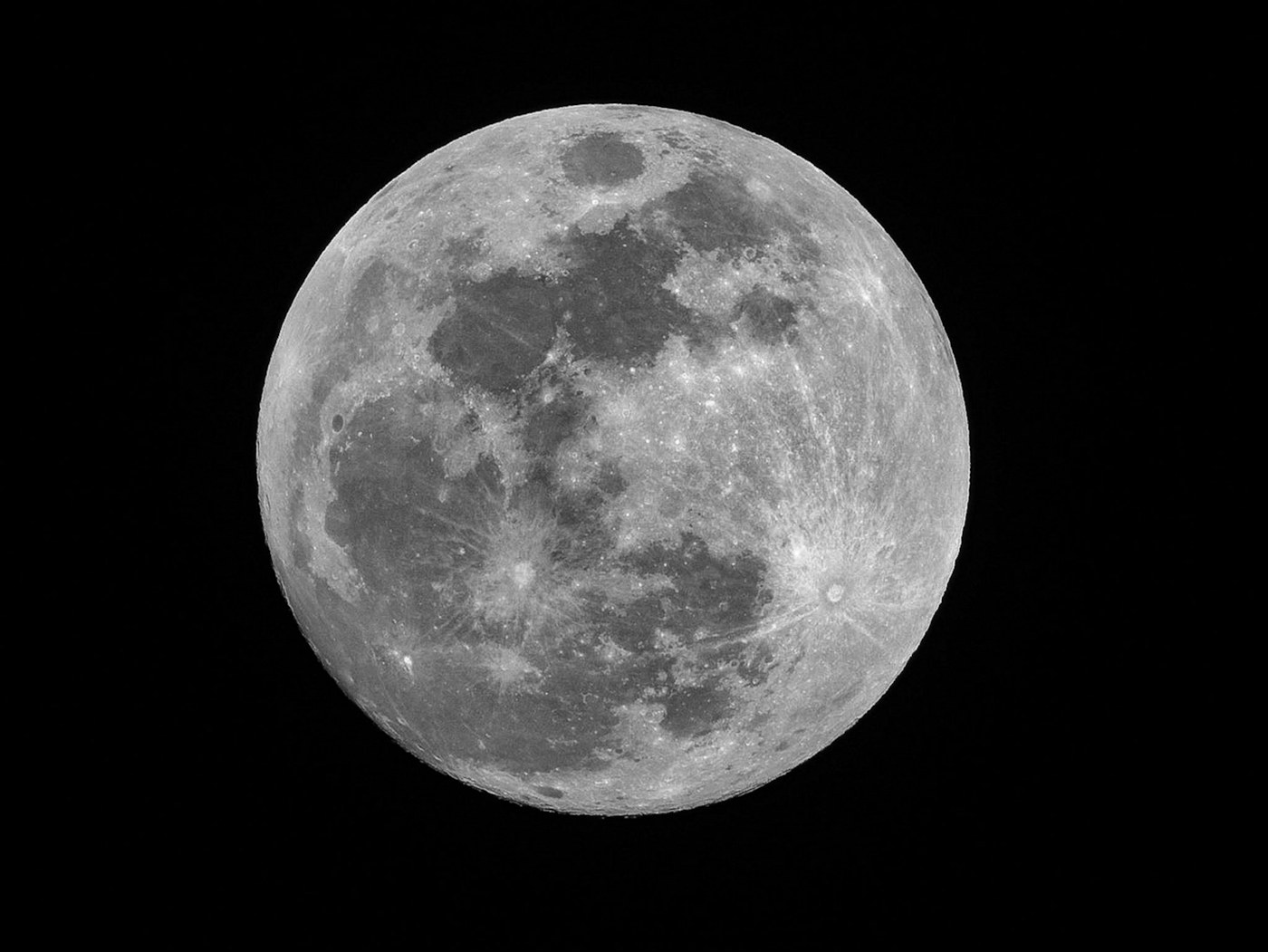
A sphere illuminated by the Sun
The light we see from the Moon is mostly sunlight reflected by its surface. Normally, the Sun illuminates half the lunar sphere. The other half experiences lunar night. To understand phases, separate two questions: which part of the Moon receives light, and how much of that region can we see from Earth? They are related but different questions. The second answer changes with the relative positions of Earth, Moon and Sun.
Our perspective changes during the orbit
As the Moon follows its orbit, we see different proportions of its illuminated half. When the lit area facing us is small, we observe a thin crescent. From other positions, roughly half the disc or almost the entire visible face looks illuminated. The sequence is continuous: phase names help describe it, but the visible surface does not jump from one shape to another. Between nearby nights, the difference can be subtle.
Phases are not Earth’s shadow
A common idea is that the dark region is Earth’s shadow. That explains a lunar eclipse under particular conditions rather than the usual phase cycle. Most of the time, the dark region is simply the portion facing us that receives no direct sunlight. Distinguishing the phenomena prevents confusing a special alignment with a change of perspective that occurs regularly during the orbit.
Keep an observation diary
Choose several days over a few weeks and record the date, time, approximate position and apparent shape of the Moon. Draw the disc’s outline and shade the unilluminated part. If you cannot find it, record that too: its position and visibility times change. You need not conclude the observation failed. A note about cloudy skies, buildings blocking the horizon or unsuitable timing also helps interpret the collection.
A simple experiment to understand the geometry
Represent the Moon with a ball and the Sun with a fixed torch in a dim space. Keep the ball away from your face and move it around yourself, observing how much of its illuminated area you can see. The model helps explain lighting, but does not reproduce real distances or sizes. Describe each position before assigning a name. The essential point is that the ball remains whole even when only a small portion appears bright.